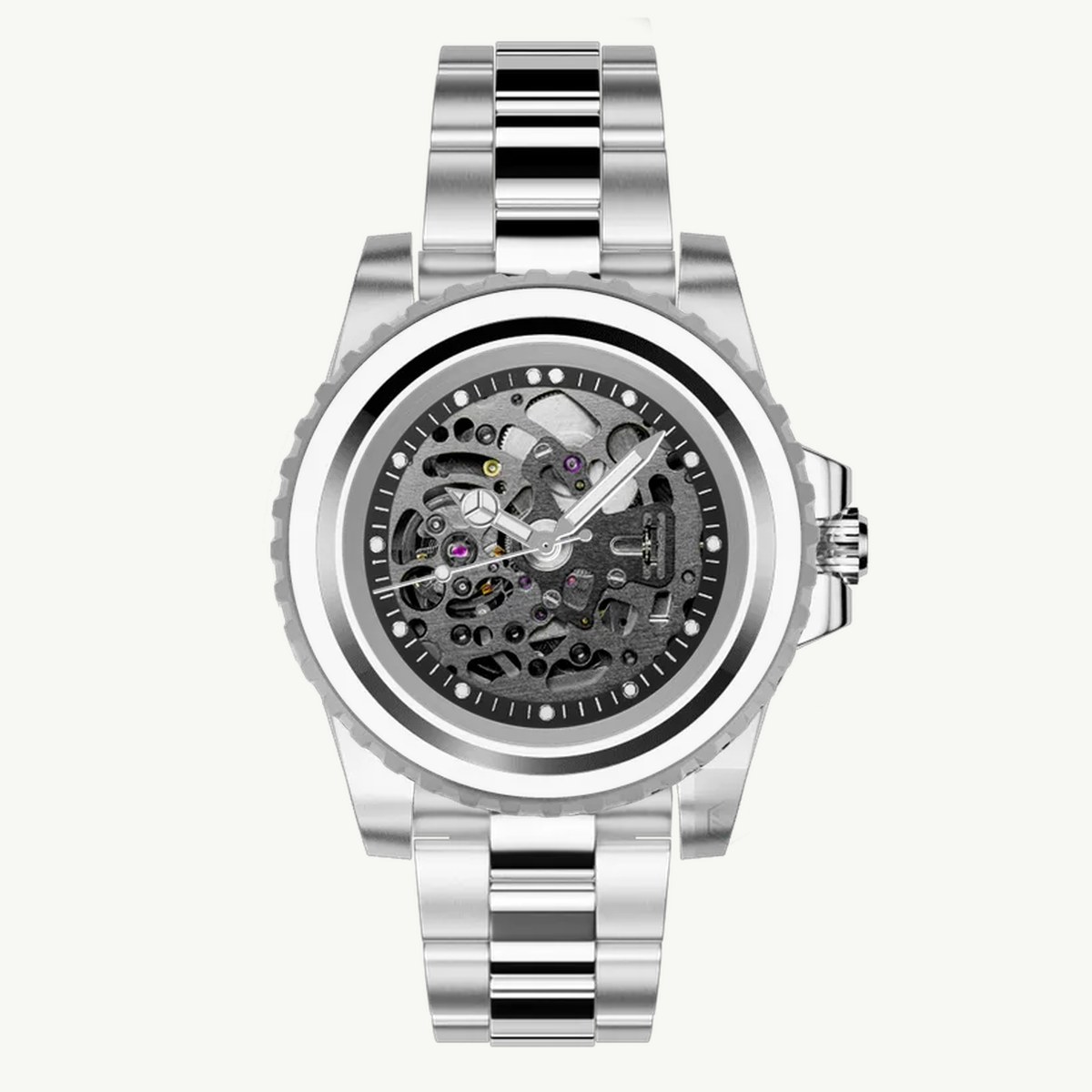
Most custom watches sold online are assembled somewhere between the factory that made the case and the courier that delivers it. The seller picks parts from a catalogue, has them shipped to a third party who presses the hands on, and puts their name on the box. That is a legitimate way to run a shop. It is not what we do, and the difference shows up in two places: how long a watch keeps time, and what happens when it does not.
What actually happens to your watch
Every build passes through the same seven stages, in the same room, with the same two pairs of hands.
- Inspection. Case, dial and hands are checked against the order under a loupe before anything is touched. A dial with a dust speck under the lacquer goes back — once it is under the crystal, it is there for the life of the watch.
- Movement fit. The NH35 is seated in its spacer ring and checked for play. A loose movement rotates slightly when you wind it, and that rotation is what eventually snaps a dial foot.
- Dial and hands. Fitted dry first, to confirm the date window lines up with the date wheel at 00:00. Then set again with the hands at exactly 12, using a hand-setting tool rather than fingers and hope.
- Crystal. Pressed with a proper press and a flat die, never a vice. A crystal seated at an angle passes a water test on the day and fails six months later.
- Casing. Stem cut to length, crown and gasket checked, case back torqued.
- Regulation. This is the part nobody photographs. The watch sits on a timegrapher and we adjust the regulator arm until the rate is inside +8/−5 seconds a day in the dial-up position, with the beat error under 0.4 ms.
- Timing check and pressure test. Twenty-four hours on the bench, then a pressure test to the depth the case is rated for.
The number that matters is not “accuracy”
A watch does not run at one rate. It runs at a different rate in every position, and the spread between them is called the positional variation. A movement that is +2 seconds a day dial-up and −25 seconds a day crown-down is technically “accurate” on a sheet and a nuisance on a wrist.
Regulation is not making a watch fast or slow. It is making it consistent.
We regulate in two positions and report the spread, not a single number. If you ask us what your watch does, you get the timegrapher readout, including the parts that are not flattering.
What we will not pretend
The NH35 is a robust, cheap, well-understood movement. It is not a Swiss chronometer and it will not become one because we put it in a nice case. What we can control is the assembly, the cleanliness, the regulation and the pressure seal — and those four things account for most of the difference between a watch that lasts ten years and one that starts fogging up in the second winter.
If that sounds like the minimum rather than a selling point, it is. We would rather tell you what the minimum actually involves than invent a heritage for a workshop that started recently.
Written by AuraMod · 10 November 2026