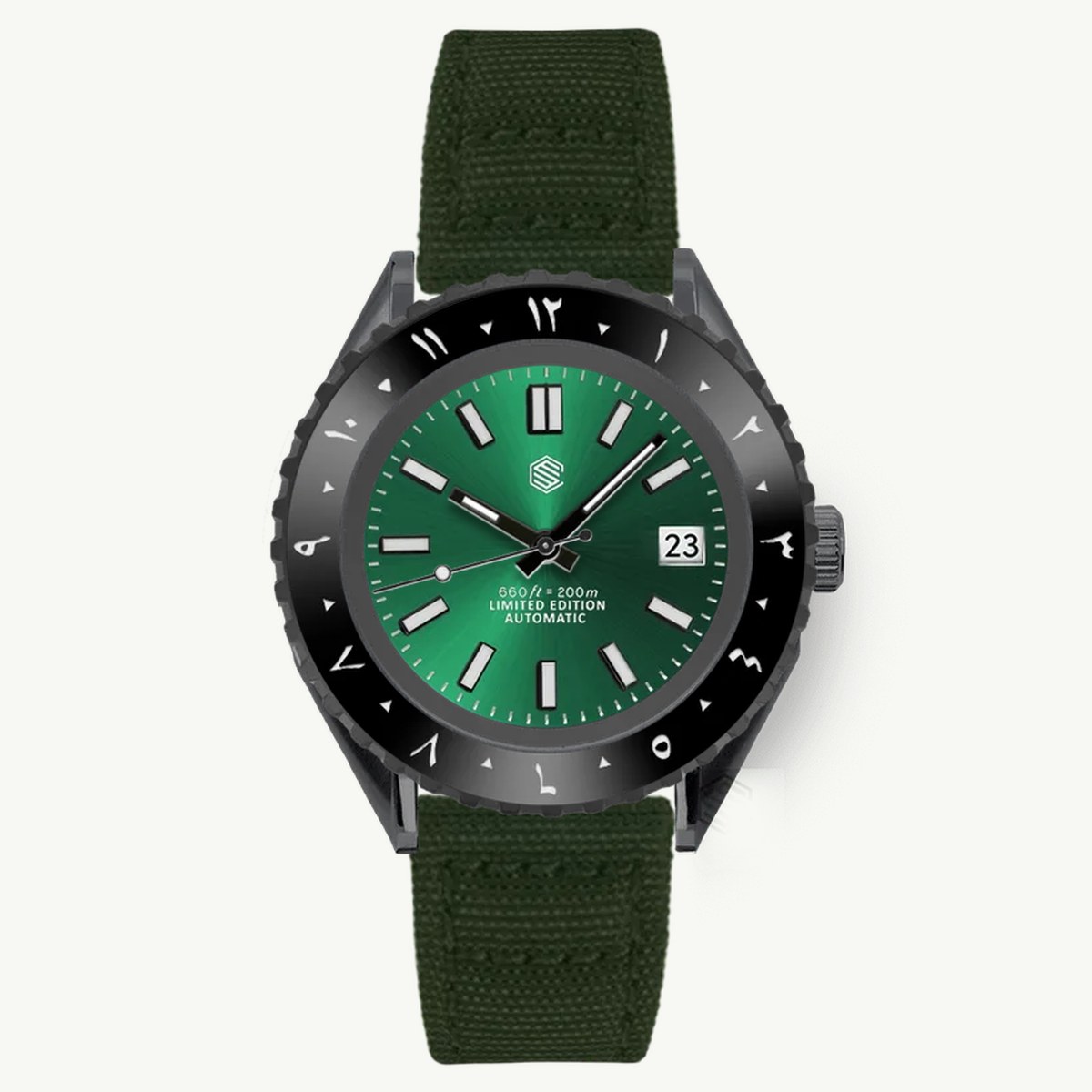
The configurator asks you to make ten decisions. Nine of them are about how the watch looks. The tenth is about how it feels every single day, and it is the one people leave until last and regret most.
The order of decisions
Case, bezel, insert, chapter ring, dial, hands, GMT hand, seconds hand, date magnifier, strap. It reads like a list of parts, and it is really a list of constraints. A 40 mm case with a 20 mm lug width will not take the 22 mm strap you liked. A GMT hand needs a movement with a fourth pinion. A cyclops needs a flat crystal with the right refractive index, or it turns the date into a smear.
This is why the configurator prices as you go rather than at the end, and why some combinations simply are not offered. The parts that fit together are the parts we can guarantee.
Dial legibility is a decision, not a taste
A matte black dial with polished gold indices photographs beautifully and disappears at dusk. A white dial with black printed indices looks plain in a product shot and is readable in a dim restaurant. Neither is better. They are different tools, and the person who buys the first one because of a photograph is often the person who stops wearing it.
If you only remember one rule: contrast beats colour. The hour hand should separate from the dial before it separates from the bezel.
Then there is the strap
The strap is the only part of the watch that touches you. It decides whether the watch sits still on the wrist or slides, whether it takes ten seconds or two to put on, and whether you can wear it in summer.
- Steel bracelet. Heaviest, most adjustable, best in heat, hardest to size at home. The right answer if the watch will be your daily.
- Rubber. The only strap that is genuinely better wet than dry. Trades formality for function.
- Leather. Best in the first month, worst in the fourth. A leather strap on a daily wear watch is a consumable, not a component.
- NATO / fabric. Lightest and most forgiving of a slightly-too-loose fit, which matters more than people admit.
How to actually choose
Start from the last wear you can picture. If it is a Tuesday at a desk, choose the bracelet and make the dial plain. If it is a Saturday in water, choose the rubber and do not apologise for the colours. Then build backwards through the nine visual decisions, because every one of them is cheaper to change now than after the hands are pressed on.
You can always order a second strap. You cannot easily re-drill a case for a different lug width.
Written by AuraMod · 12 November 2026